
A new start for Public Appointments in Wales
The importance of Public Appointments
We encounter public services everywhere we look, from local authorities dealing with education, recycling, roads; to Welsh Government that implements policy and sets strategic direction; to NHS health boards that most of us will encounter – and appreciate – at multiple points in our lifetimes.
The list of all 97 public bodies highlights the extraordinary breadth of public bodies – and the importance of the work that they carry out.
Each of those organisations has people who carry out the ‘doing’ – the nuts and bolts of what the organisation is supposed to deliver. They also have a Board to exercise the governance that can give assurance to Welsh Ministers, and of course to the rest of us, that those organisations are doing the best they can according to the tasks they have been set, and that they are appropriately considering risk, balancing choices, and planning for the future.
Serving on a Public Board is a public good; many of those board positions are paid, some are not. None of them are remunerated at a level equivalent to a similar role in the private sector. So the calibre of appointees, each of which is made by a Minister, is incredibly important; and so, too is the pool of potential candidates.
How it used to be
The public appointments process in Wales used to mirror similar processes elsewhere; submit a CV and a letter, outlining your skills and experience that are aligned with the role. Often (in my experience!) the job descriptions were wordy and, if we’re honest, contained so many essential criteria that it was impossible to do all of them justice within either the CV or the letter; which meant even highly qualified candidates were left to second-guess which ‘essential’ criteria to address, and which to drop.
This isn’t a particular criticism of the approach in Wales – as I say, this seems to be more or less ubiquitous in recruitment at senior levels in the public sector.
Managing the change process
Changing a process of this importance and complexity can’t be done overnight; fair play to Welsh Government, they have really worked hard on the process. The first step was an all-day event in Cardiff to gain feedback from stakeholders on what needed to change. If you missed it, you can read all about it on this website 😀
Following that event, Welsh Government tendered for support to help with the design of a new public appointments system. GatenbySanderson, who sponsor this website, were successful in their bid, and I was very pleased to be able to offer my support to them as part of the design process.
The consultation didn’t end with that public event. We had two further sessions for invited contributors that further embedded the philosophy of equity and support within our thinking.
The underpinning values and philosophy
The feedback from all the stakeholder consultation was clear. The current process:
- Defined merit too narrowly
- Favours insiders
- Implicitly creates barriers for neurodivergent candidates, or those from ‘non-traditional’ board backgrounds
- Creates reams of paperwork, both on the recruiter and recruitee sides
- Lacks a clear methodology for incorporating lived experience as a valuable part of a potential Board contribution
- Militates against non-traditional career paths
The feedback on improvements included:
- Redefine what counts – assessment of behaviours applied consistently across all Boards, supplemented by role-specific skills and experience
- Incorporate a ‘Nolan-plus’ approach of behaviours that are crucial to Board success and function, such as courage, curiosity, emotional intelligence
- Make a much clearer and simpler process
- Better interviews!
- Flexible formats to help candidates describe their own narrative
- Accessible by default
- Better feedback from unsuccessful attempts
- Build a pipeline
- Support applicants through improved training and learning materials
The work that has been put into the new arrangements should result in improvements in each of these areas. I anticipate that public appointments will be seen as more accessible, resulting in a wider candidate pool. It’s crucial to the success of our public bodies that we harness a more diverse perspectives that can help us solve problems using a wider range of personal and professional experiences.
The outcome?
This was not a trivial project; I want to pay credit to the public appointments team at Welsh Government; to those who gave their time generously in providing their thoughts on how the system should be improved; and to Rosemary (in particular) of GatenbySanderson for her tireless work and expertise.
I hope that the outcome which includes a new pack for applicants and for panel members meets many (perhaps not all!) of our expectations as people on both sides of recruitment.
I know that it won’t meet everybody’s expectations, and some of that is simply down to resource. For example, in my reflections at the Millennium Stadium, I described how I had had a brilliant rejection because the feedback had been so useful. The public appointments team is not able to match that level of detail at the moment, but I think it remains an aspiration, and the new system is designed to help panel members provide feedback that has real value to applicants.
I invite you to read the guidance and form your own opinions. The intention behind the design is:
- To become fully aligned with Future Generations and Nolan principles. Every role will incorporate four behavioural areas rather than technical criteria.
- To provide a process that emphasises substance over style
- To improve the interview component and make it more like a ‘real’ Board situation
- To allow lived experience to become assessed as part of evidence in each area
- To support the provision of feedback that has genuine value to applicants, helping to keep people motivated to apply in future
Naturally the proof of this pudding will be in the eating; we will shortly see whether it lives up to expectations.
Rest assured, if you’re in charge of a public appointments recruitment exercise, there is material to support you as you get used to this new way of doing things. There is also the intention to keep the process open to review and improvement as new feedback is received from its deployment ‘in the field’.
For me the ambition has been to improve the system rather than reach perfection. However I’m delighted by the way that the new process is so strongly aligned with Future Generations principles. I believe that this step has shown that – at least in this area – Wales is leading the way.
No AI was used in the drafting of this blog post. It is entirely the product of David Clubb’s brain.
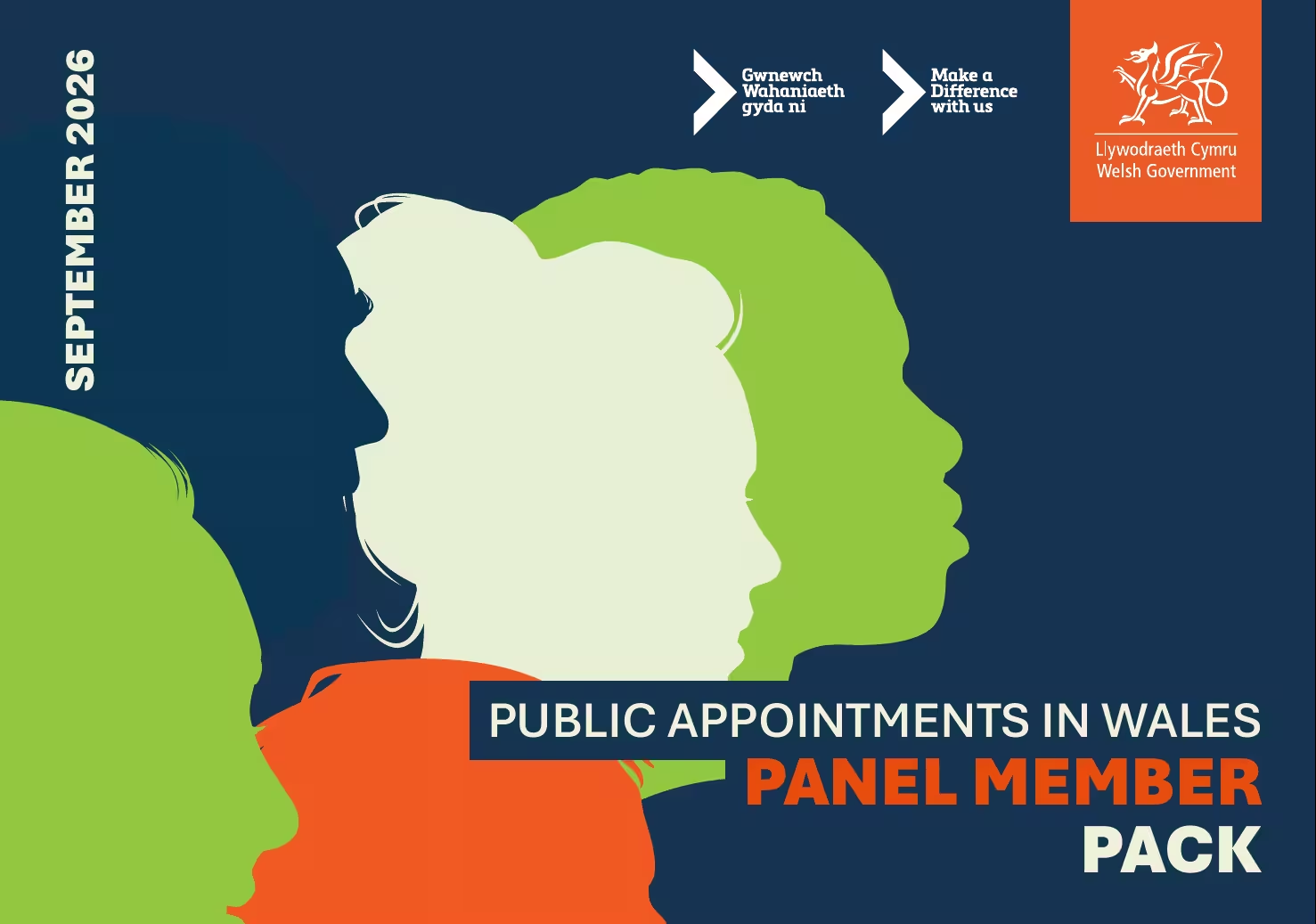
Photo: front cover of the Welsh Government guidance pack.